Smart REM
Sensor-Based flashing
Smart REM › Sensor-Based
Lay the phone on the mattress, screen up. Ludin monitors your phone's motion sensors while you sleep, works out when to cue, and flashes the screen red — then keeps monitoring until you stop it. The screen stays black the whole time. This is the mode Ludin exists for.
Do this after a WBTB wake, or with a midday nap. This tool is designed to be armed as you go back to sleep — either after a Wake-Back-to-Bed wake, or at the start of a midday nap. Sleep you re-enter that way reaches REM far sooner and holds it far longer than sleep you're just beginning, so the cue has real dream to land in. Armed at bedtime instead, it spends the first hours firing into non-REM sleep, where there's very little to become lucid inside.
Sensor-Based takes the guesswork about when to fire off your hands — but it can't manufacture REM that isn't there. Give it a nap or a post-WBTB sleep and it has something to work with.
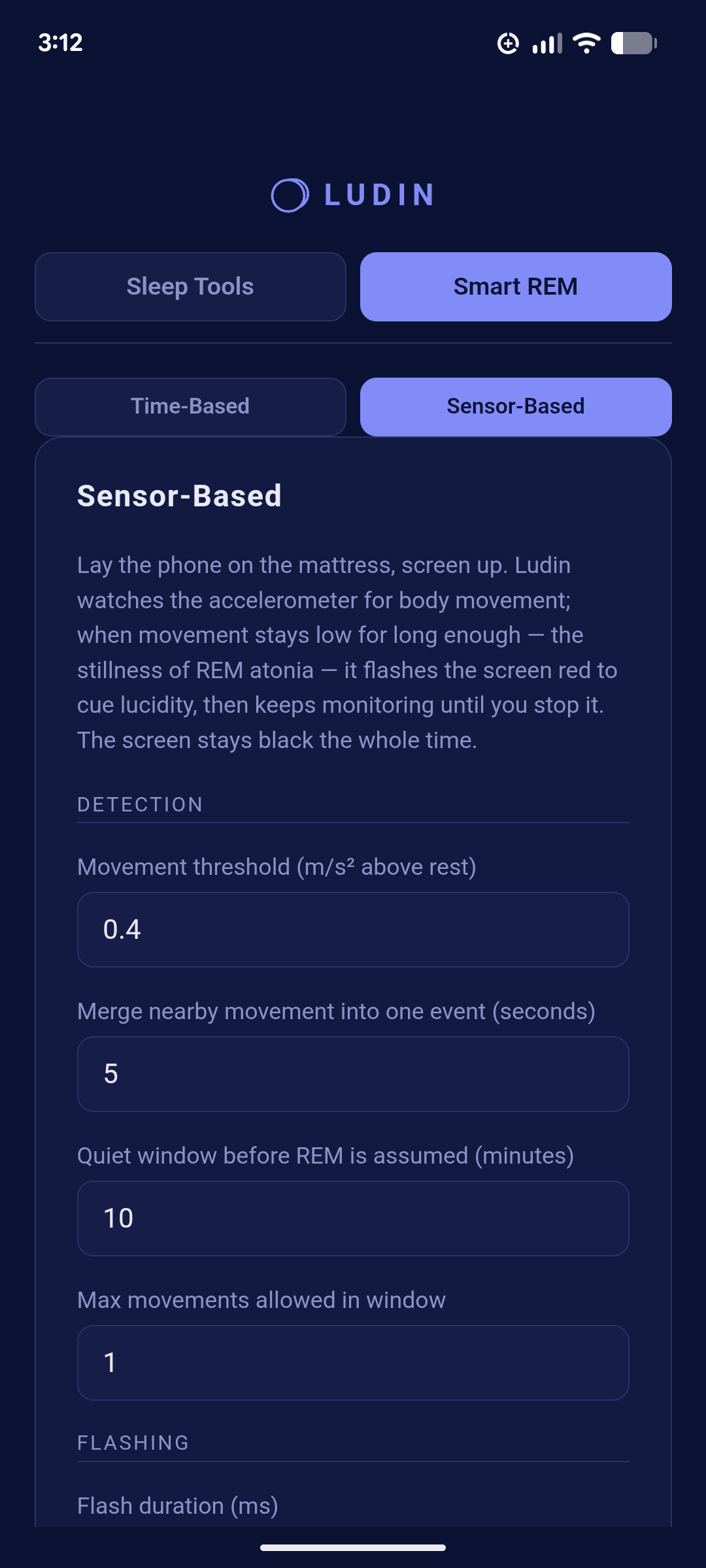
docs/images/smart-rem-sensor-based.pngDetection settings
These control how readily Ludin decides to cue. The defaults are a sensible starting point — change them only if you're troubleshooting a specific problem, and change one at a time.
| Setting | Default | Effect |
|---|---|---|
| Movement threshold (m/s² above rest) | 0.4 | Sets how much motion counts as movement rather than background. Raise it and Ludin cues more readily; lower it and it becomes more selective. |
| Merge nearby movement into one event (seconds) | 5 | Movements closer together than this are treated as one. Stops a single bout of shifting position from registering over and over. |
| Quiet window before REM is assumed (minutes) | 10 | How long conditions have to hold before Ludin cues. Longer is more selective and fires less often; shorter fires more often. |
| Max movements allowed in window | 1 | How much movement that window tolerates before it's discarded. Higher is more forgiving — useful on a shared bed, or if you're a restless sleeper. |
If in doubt, don't. The defaults are tuned; most people should leave them alone and change placement or session timing first. If you do need to adjust something, Troubleshooting tells you which setting to move for which symptom.
Flashing and re-arm
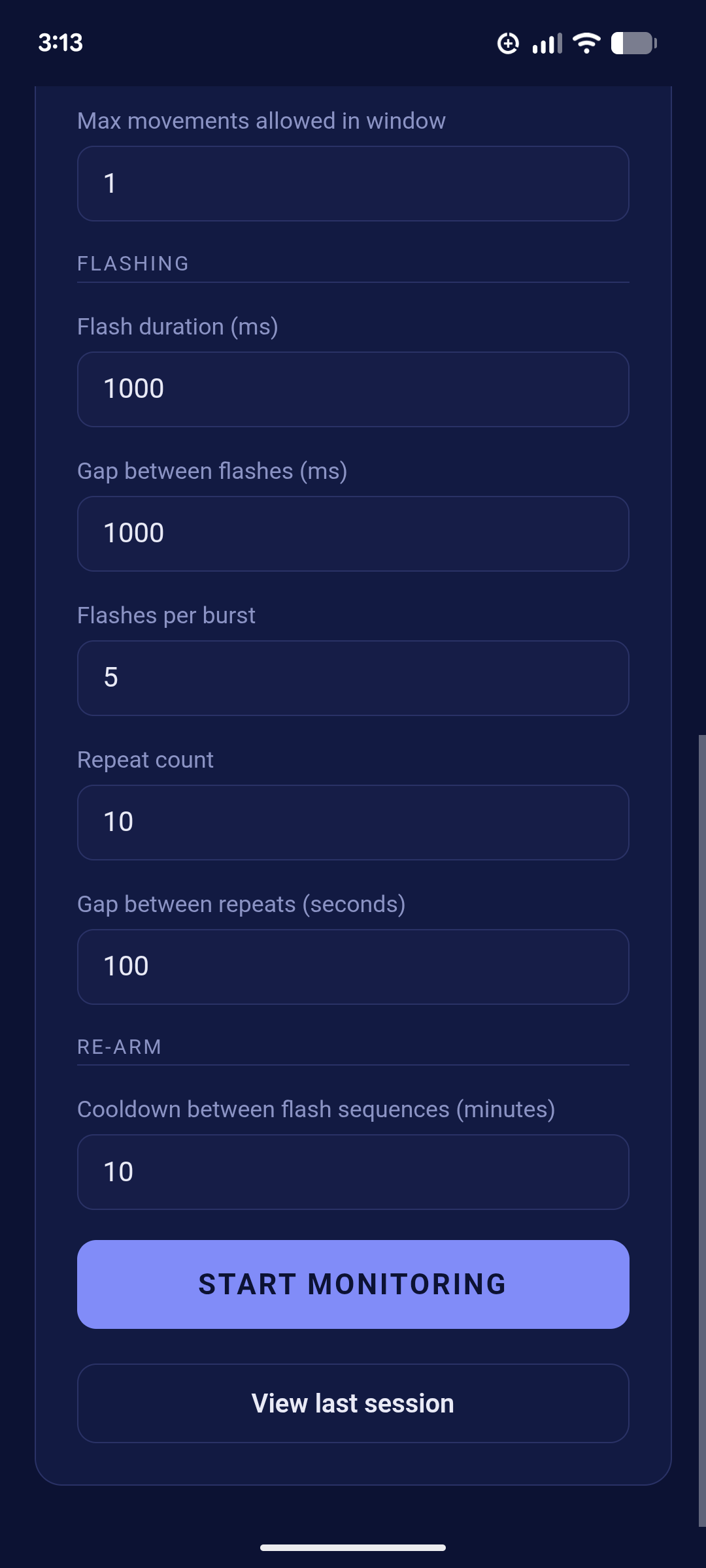
docs/images/smart-rem-sensor-based-flashing.png| Setting | Default | What it does |
|---|---|---|
| Flash duration (ms) | 1000 | How long the screen stays lit for each flash. |
| Gap between flashes (ms) | 1000 | The dark interval between flashes within a burst. |
| Flashes per burst | 5 | How many flashes make up one burst. |
| Repeat count | 10 | How many bursts fire in the sequence. |
| Gap between repeats (seconds) | 100 | The pause between one burst and the next. |
| Cooldown between flash sequences (minutes) | 10 | After a full sequence finishes, how long Ludin waits before it's allowed to fire again. Stops it re-triggering repeatedly on the same REM period. |
These defaults are much gentler than Time-Based, and far longer. Ten bursts of five one-second flashes, spaced 100 seconds apart, spans roughly a quarter of an hour — against about 30 seconds for the Time-Based defaults. A slow, patient cue that keeps offering itself works better here than one sharp attempt.
Running it
Press Start monitoring. The screen stays black the entire time — tap it to come back. Unlike Time-Based, Ludin keeps watching after it fires, so one arming can cue several REM periods across a nap or a post-WBTB sleep. It runs until you stop it.
View last session brings up the record of your previous run — the place to look when you want to know whether anything fired and when.
Where to put the phone
On the mattress, screen up. Screen up matters: the flash has to be able to reach you. Not on a nightstand, not on a shelf, and not buried under a pillow that muffles both the motion and the light. Somewhere it won't be knocked to the floor.
Placement matters more than any setting. A partner or a pet on the same mattress adds movement that isn't yours, and different mattresses behave very differently. If results are inconsistent, change placement before you touch anything else — and change one variable at a time.
Your sleep data stays on your phone. Detection runs entirely on-device. Nothing is uploaded for it to work.
Photosensitivity. This mode flashes bright light repeatedly. If you have photosensitive epilepsy or are sensitive to flashing light, don't use it — Timed Audio is a non-flashing alternative.
Being straight with you about the evidence. Across the first 25 testers, the median tester reported that 45% of their remembered dreams became lucid. That's an early-cohort figure: n=25, self-reported rather than lab-verified, uncontrolled, and measured per remembered dream rather than per night — so it isn't comparable to the ~17%-of-nights figure published for MILD + WBTB. The underlying data is at ludin.app/test-results, published as we earn it.
The tuning guide for this mode — sensible starting values for restless sleepers and shared beds, what to do with a session that produced no cue at all, and how to read View last session.