Sleep Tools
WBTB Timer
Sleep Tools › WBTB
Wake-Back-to-Bed is the best-evidenced lucid dreaming technique there is: wake after several hours of sleep, stay up briefly, then go back to bed. Ludin does the arithmetic — you tell it when you're going to sleep, it lists the wake time at each cycle boundary, and you arm the one you want.
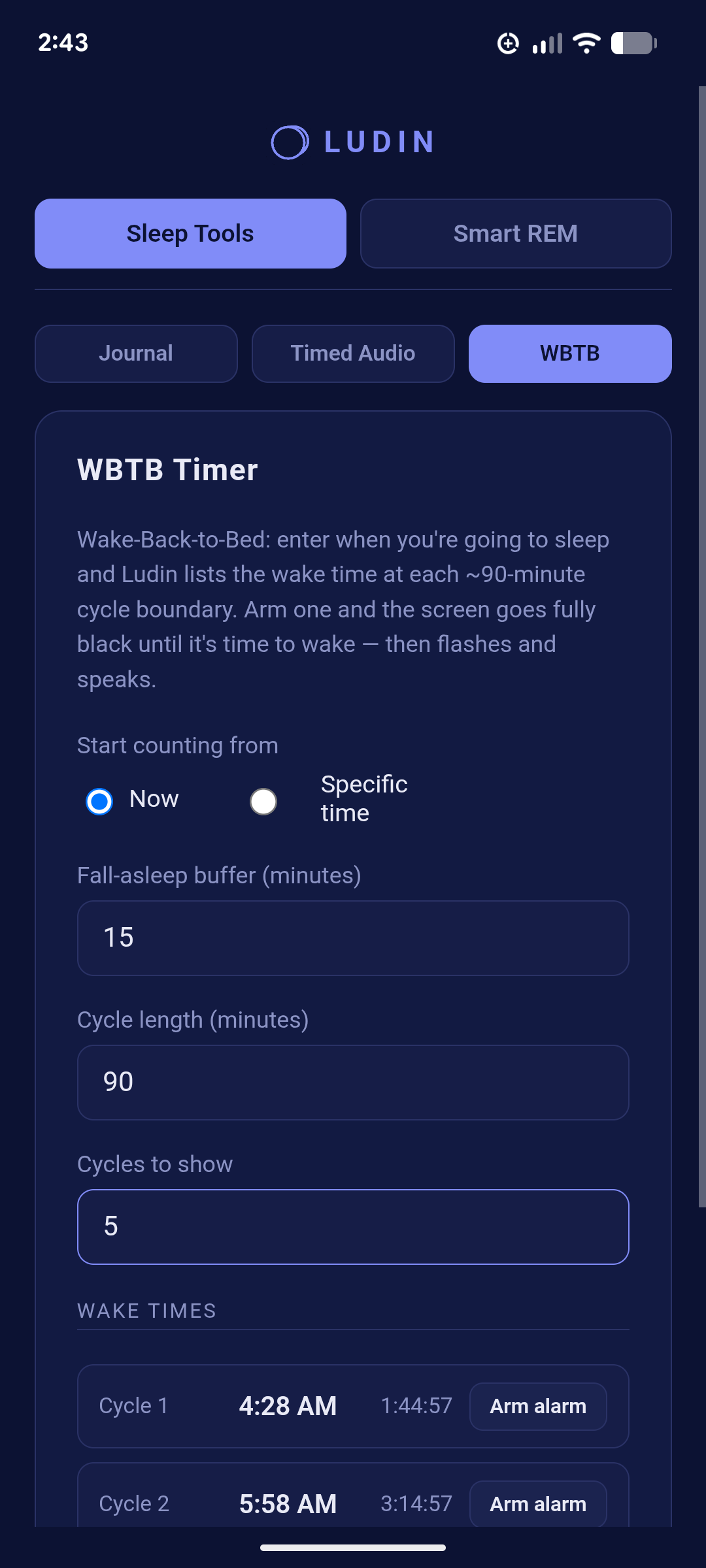
docs/images/wbtb.pngSettings
| Setting | Default | What it does |
|---|---|---|
| Start counting from | Now | Now counts from the moment you're looking at the screen. Specific time lets you plan ahead — useful if you're setting this up before you actually go to bed. |
| Fall-asleep buffer (minutes) | 15 | How long you take to actually fall asleep. Cycles are counted from the moment you're asleep, not the moment you lie down, so this shifts every wake time later. |
| Cycle length (minutes) | 90 | The assumed length of one sleep cycle. 90 is the population average; real cycles vary roughly 80–110 minutes and vary within a night. |
| Cycles to show | 5 | How many wake times to list. |
The wake-times list
Each row gives the cycle number, the clock time, a live countdown, and an Arm alarm button. Arm one and the screen goes fully black until that time, then flashes and speaks to wake you. Tap the black screen at any point to come back.
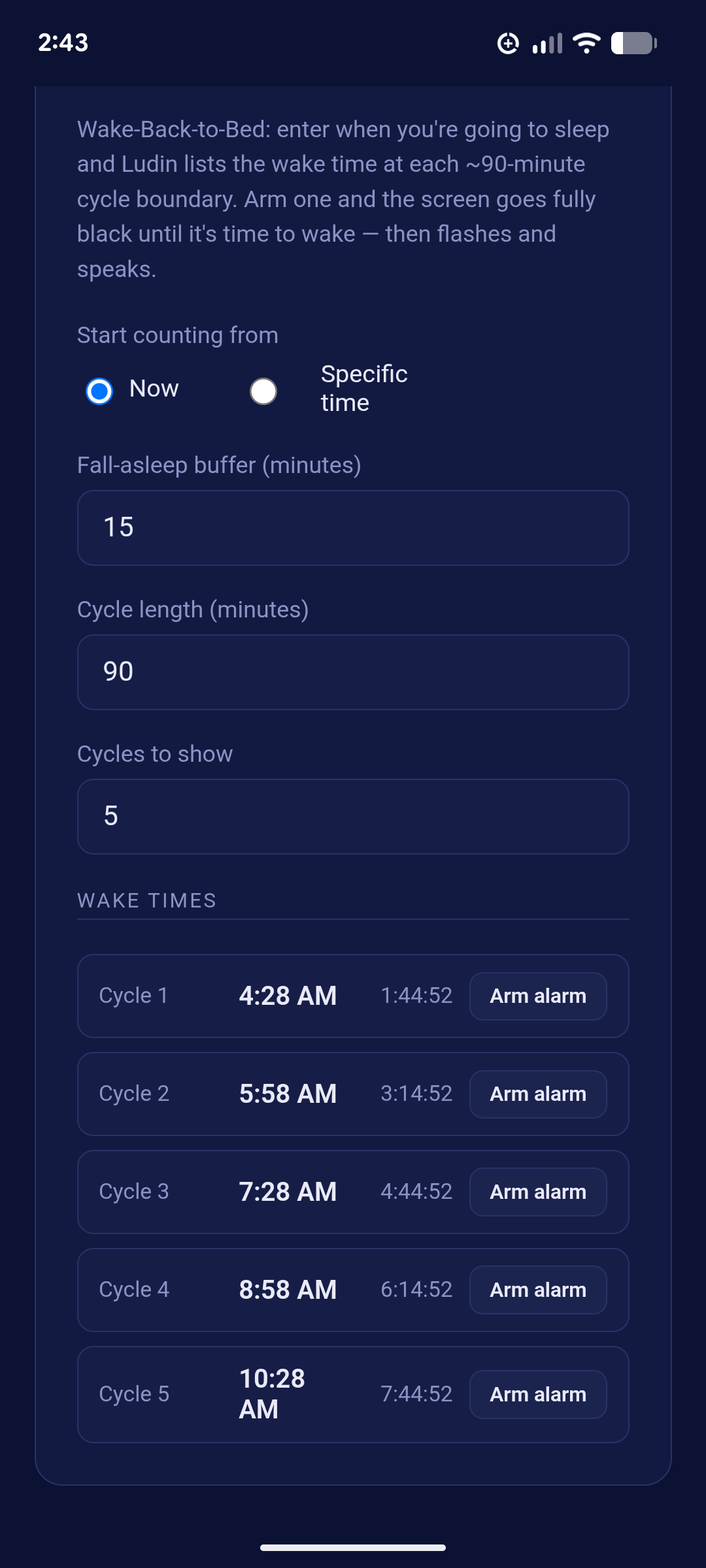
docs/images/wbtb-wake-times.pngWhich cycle to pick
Cycle 4 or 5 — roughly 4.5 to 6 hours in — is the conventional target. Two reasons: you've already banked most of your deep sleep, so the interruption costs less; and the REM periods that follow are the longest of the night, which means more dream to become lucid inside.
Once awake, stay up for 15–30 minutes doing something quietly engaging, then go back to bed intending to recognise the dream. The wake gap is doing real work here — going straight back to sleep is much less effective.
WBTB has a real cost. Deliberately fragmenting your sleep reduces restorative slow-wave sleep and can leave you groggy the next day. Use it on nights when tomorrow can absorb it — not every night, and not before something that matters. If you have a sleep disorder or you're already sleep-deprived, this is not the tool to start with.
This is step one, not the whole method. WBTB on its own is a well-timed alarm. Its real job here is to set up the cue: once you're getting back into bed, arm Sensor-Based or Time-Based flashing, or Timed Audio. The sleep you're re-entering is dense with REM, which is exactly what those tools need — and exactly what they don't get if you arm them at bedtime.
The full sequence: arm a wake time → wake → stay up 15–30 minutes → arm a cue tool → back to bed.
The gentler alternative: a midday nap
If broken sleep isn't worth it to you, a midday nap does a similar job at a fraction of the cost. You reach REM quickly in a nap, and you can arm a cue tool as you lie down without touching your night's sleep at all. If you're new to this, the nap route is the easier place to start — and you can run it on a weekend afternoon instead of at 4am.
How to estimate your own cycle length instead of assuming 90 minutes, and how to sequence WBTB with the Smart REM modes on the same night.