Smart REM
Time-Based flashing
Smart REM › Time-Based
Arm a delay and Ludin flashes the screen red once it elapses — timed manually to try to catch REM, the same way the original light-flash induction devices worked. Nothing is being measured here; you are the REM detector.
Do this after a WBTB wake, or with a midday nap. This tool is designed to be armed as you go back to sleep — either after a Wake-Back-to-Bed wake, or at the start of a midday nap. Sleep you re-enter that way reaches REM far sooner and holds it far longer than sleep you're just beginning, so the cue has real dream to land in. Armed at bedtime instead, it spends the first hours firing into non-REM sleep, where there's very little to become lucid inside.
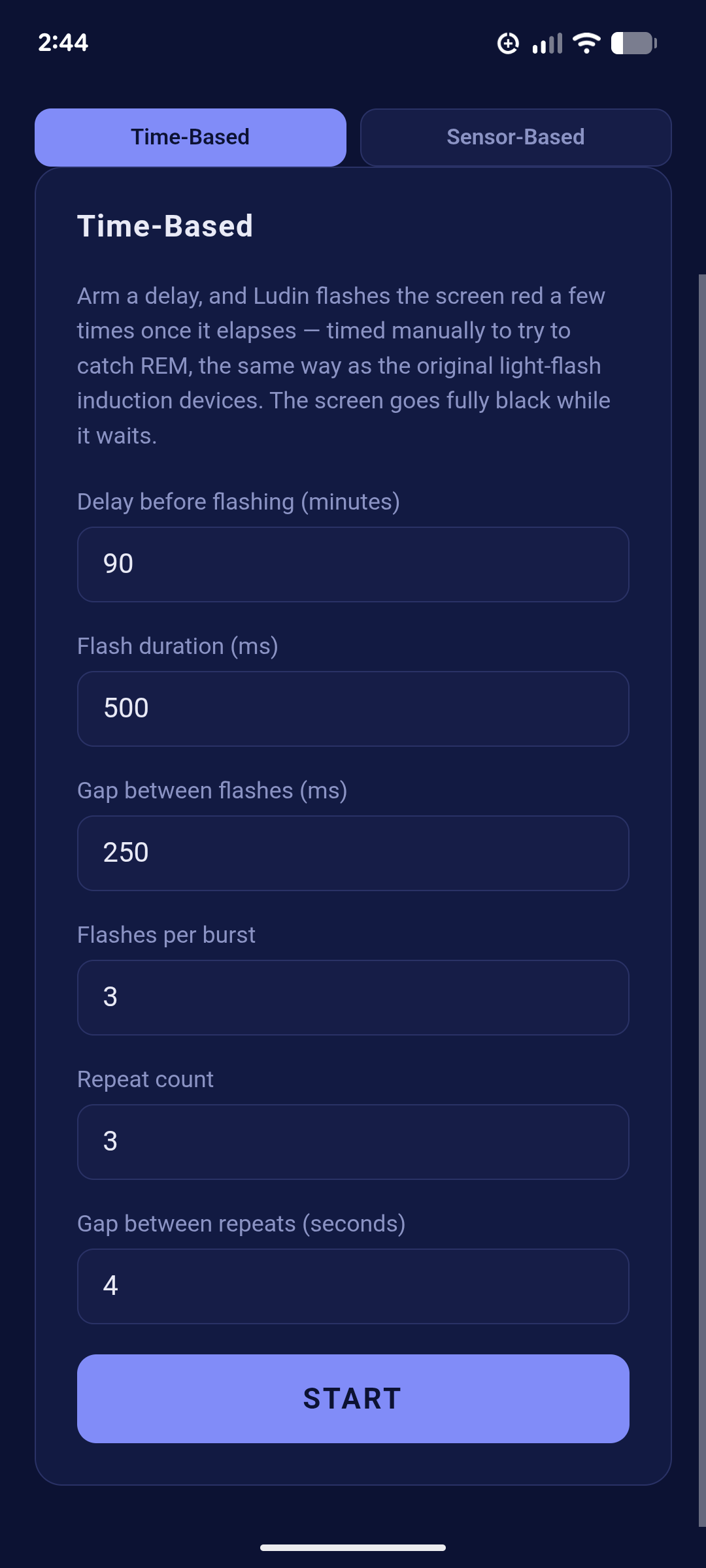
docs/images/smart-rem-time-based.pngSettings
| Setting | Default | What it does |
|---|---|---|
| Delay before flashing (minutes) | 90 | How long Ludin waits after you press Start before the first burst. Counted from arming, so include your own fall-asleep time in the number. The 90 default is a starting point, not a recommendation — see below. |
| Flash duration (ms) | 500 | How long the screen stays lit for each individual flash. |
| Gap between flashes (ms) | 250 | The dark interval between flashes within a single burst. |
| Flashes per burst | 3 | How many flashes make up one burst. |
| Repeat count | 3 | How many bursts fire in total. |
| Gap between repeats (seconds) | 4 | The pause between one burst and the next. |
Read together, the defaults produce three bursts of three half-second red flashes, four seconds apart — about 30 seconds of cueing in total, starting 90 minutes after you press Start.
Choosing the delay
This is the setting that decides whether the whole thing works, and what you set it to depends entirely on when you armed it.
After a WBTB wake, or for a nap — the intended use
This is the case the tool is built for, and the delay is short. You're covering two things only: the time you take to fall asleep, and the run-up to the first REM period. Sleep you re-enter after a few hours awake in the night, or a midday nap taken at the right time, reaches REM considerably sooner than sleep at bedtime does — you're dropping into a sleep architecture that's already REM-heavy rather than working through a full cycle to get there.
Start by timing your own fall-asleep, add your estimate of the run-up, and use the repeat count to cover the error rather than trying to hit the moment exactly. Several bursts across a window will beat one perfectly-aimed guess.
If you arm it at bedtime anyway
Then you're waiting out whole cycles of roughly 90 minutes, with REM sitting at the end of each — boundaries near 90, 180, 270, 360 and 450 minutes. Aim late: early-night REM periods are often only a few minutes long, while by the fourth and fifth cycles they can run 20–40 minutes.
Add your fall-asleep time on top. If you take 20 minutes to drop off and you want the burst at the end of cycle 4, that's 20 + (4 × 90) = 380 minutes, not 360. This works, but it asks a lot of a delay that's blind — which is why the nap/WBTB approach is the recommended one.
Shaping the burst
The tension is always the same: strong enough to register inside the dream, gentle enough not to pull you out of it. If you keep waking fully, shorten the flash duration or cut the flashes per burst before you touch anything else. If nothing registers at all, add repeats rather than making individual flashes longer — more chances to catch a dream beats one brighter attempt.
Photosensitivity. This mode flashes bright light repeatedly. If you have photosensitive epilepsy or are sensitive to flashing light, don't use it — Timed Audio is a non-flashing alternative.
Running it. Press Start and the screen goes fully black while it waits. Tap anywhere to come back to the app.
A full guide to tuning these constants — concrete delay numbers for naps and post-WBTB sleep, how the burst parameters interact, which ones to change first, and how to run a sensible experiment across a week rather than changing everything every night.